


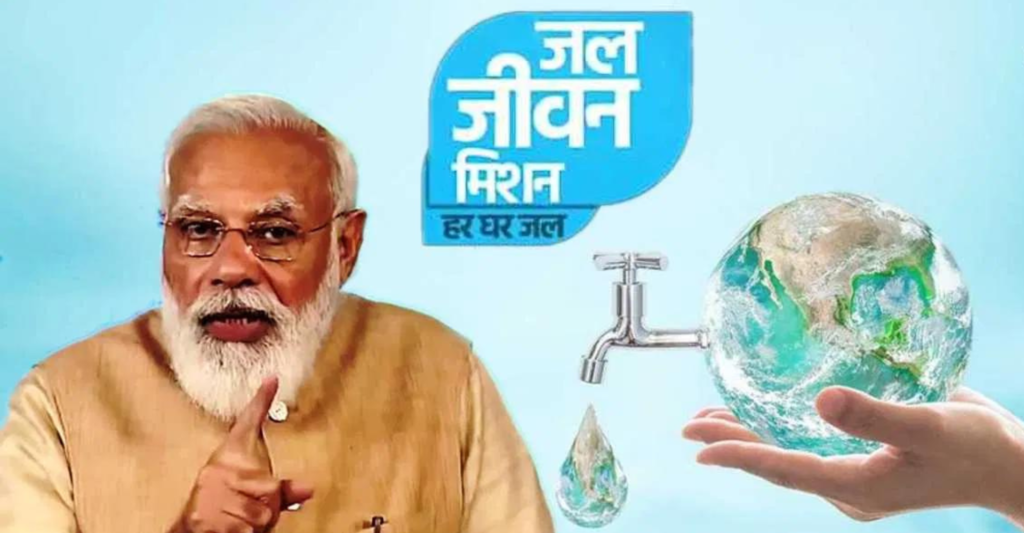

The Jal Jeevan Mission (JJM), launched by the Government of India under the leadership of Prime Minister Narendra Modi in August 2019, is a flagship initiative aimed at ensuring access to safe and potable drinking water to all rural households across the country. The mission is guided by the vision of “Har Ghar Jal” (Water to Every Household) and seeks to empower rural communities by providing them with sustainable water supply solutions.
Background
Access to clean and safe drinking water is a fundamental human right and a crucial determinant of public health, economic development, and overall well-being. In rural India, millions of households still lack access to piped water supply, forcing them to rely on contaminated sources such as ponds, rivers, and hand pumps, leading to waterborne diseases and other health hazards.
Objectives
The primary objective of the Jal Jeevan Mission is to provide piped water supply to all rural households, ensuring access to safe drinking water for drinking, cooking, and other domestic needs. The mission aims to promote community participation, sustainable water management practices, and the conservation of water resources.
Key Features
Community Participation: The Jal Jeevan Mission emphasizes community participation and ownership by involving local communities, Gram Panchayats, and Water User Committees in the planning, implementation, and management of water supply schemes.
Convergence and Integration: The mission promotes convergence with other government schemes and programs related to water supply, sanitation, and rural development to maximize impact and efficiency.
Technology and Innovation: The mission encourages the adoption of appropriate technologies and innovative solutions for water supply, including rainwater harvesting, groundwater recharge, and water conservation measures.
Capacity Building: Capacity building and training programs are conducted to empower local stakeholders, including village-level functionaries, technicians, and community leaders, in water management, operation, and maintenance of water supply systems.
Monitoring and Evaluation: Robust monitoring and evaluation mechanisms are put in place to track progress, assess the quality of water supply services, and ensure accountability and transparency in implementation.
Progress and Impact
Since its inception, the Jal Jeevan Mission has made significant progress in providing piped water supply to rural households across India. Millions of households have been provided with tap connections, reducing their dependency on unsafe water sources and improving their health and well-being. The mission has also contributed to gender empowerment by reducing the burden of water collection, primarily borne by women and girls.
Moreover, the Jal Jeevan Mission has spurred economic development in rural areas by enhancing productivity, promoting livelihood opportunities, and stimulating investments in water-related infrastructure and industries.
Challenges and Way Forward
While the Jal Jeevan Mission has achieved commendable success, challenges such as water quality management, sustainability of water supply systems, and equity in access remain. Addressing these challenges requires sustained efforts, innovative approaches, and collaboration among all stakeholders, including government agencies, civil society organizations, and local communities.
In conclusion, the Jal Jeevan Mission stands as a transformative initiative that holds the promise of ensuring universal access to safe and potable drinking water, thereby improving the lives and livelihoods of millions of rural households across India. Through its holistic approach and participatory ethos, the mission embodies the spirit of inclusive and sustainable development, paving the way for a water-secure future for generations to come.
Our vision is to address the “United Nations’ 2030 Agenda for Sustainable Development along with India 2030” by adopting a holistic strategy till 2030, through a comprehensive approach between the hierarchy of Governance and their stakeholders.


Vipin Kumar Sahu is the founder of the Indus Initiative Council and has served various Hon’ble Member of Parliament as their Political Secretary and in present working with Hon’ble Member of Parliament Shri Sangam Lal Gupta, Member of Parliament from Pratapgarh(U.P) who is also holding the office of National General Secretary BJP OBC Morcha. Mr. Sahu holds a Master’s Degree in Journalism and is having a vast experience of over 20 years in the field of Journalism and has in-depth knowledge and knowhow for the Government affairs, Schemes and Policies.
He also own’s monthly national news Magazine Rashtriya Chanakya Varta, which is performing not only the media dharma but also carrying out the social responsibility from the dais of media. Rashtritya Chanakya Varta also works over the Central and State government schemes and policies and advertises them to bring more awareness in public about the same.
Prior to founding Indus Initiative Council, Vipin always had a vision of facilitating the outreach of various social welfare schemes to the grassroots level through the concept of Constituency Development through UNSDGs. He further looks forward to build a holistic synergy between top-down model of governance by collaborating with private investors, technologists, policy- makers, thinkers amongst various others.
Vikas Singh graduated in Mass Communication and also an MBA in Marketing. He is known for his Out of the Box thinking, Creativity, Lucrative ideas for government affairs and strategies.
He has worked with various multinational companies in various engagements and helped clients across the globe in their strategy. He also witnessed how invaluable solid guidance and support of entrepreneurs, NGOs and different bodies working in the public sector can be, which serves him well in his role at Indus Initiative Council.
He started his career in 2011 and has vast knowledge for the Corporate Planningin Marketing, Strategy, Political affairs and Government Schemes and serves as an advisor to multiple Non For Profit Organizations and Private Players.
Vinod Kataria, post graduated with a degree in Hindi literature from the Delhi University and currently a Law professional, in Delhi and Gurugram. For sixteen years he was a journalist and wrote for many national and international magazines including PC Magazine India, Electronic Components—Hong Kong, EDN Asia—Singapore, ECN Asia—Singapore, Electronics Mega Mind—India, Computer Mega Mind—India, Chanakya Varta—India, Base Line—India.
Vinod Kataria has a hobby of social work and worked voluntarily for many NGO and Trusts. He is holding the post of President with Universal Care, an NGO working for upliftment of the need and poor.
In 2012, Vinod Kataria left the journalism and became a full-time lawyer and freelance journalist. Currently, he is a lawyer and practicing in Supreme Court, Delhi High Court, Delhi District Courts and Gurugram District Courts.